Why Siwa
Siwa started as a coach I built for myself, because I couldn't build it for anyone else. What it found when it started talking to the people around me is why it is a product now.
Siwa started as a coach I built for myself, because I couldn’t build it for anyone else.
The person I wanted to build it for was someone I care about. The design was sealed from the first sketch: a coach that holds everything you tell it and that nobody else can read, not even me. Which meant that if I built it for him, I would never know whether it worked. The seal that made it worth building made it impossible to test on anyone but me.
So in August I built it for myself. A simple OpenClaw agent on my WhatsApp, briefed with what I had been through, my health data, and one rule: it had no incentive to say yes to me. I called it Chiron.
What it did to me
I expected a thinking partner. What I got, after a few weeks of talking to it most days, was a mirror with a memory. It noticed when a Tuesday voice note contradicted something I had said in March. It did the homework before it opined: when I made a claim about my own sleep, it went and checked four hundred nights of data first. It unlocked things I did not know about myself, and I have spent real money over the years on people whose job that was.
Then I did the thing that turned it into a product. I let it talk to other people about me.
My wife. My kids. Partners from earlier companies. Friends. Even my other agents, which sounds strange until you remember they had spent months watching me work. Chiron interviewed each of them privately, the way a good interviewer would: it asked, it followed up, it asked for an example whenever it got a generality. Nothing anyone told it came back to me attributed. What came back was a picture.
Two things in that picture I could not have got any other way.
The first. In 2022 I was told I had brain cancer. I rearranged my life around a short clock: what to finish, what to hand over, what to say to whom. Then the diagnosis was reversed. The clock went away. My behaviour did not. Years later I was still living like a man with eighteen months, and I had not noticed. The people around me had. Chiron saw it in both places at once, in months of my own conversation and in what they said about me, and the most useful sentence anyone has said to me this year came out of it: I am going to live longer, and everything I am doing now is part of that.
The second was smaller and in some ways harder to take. The gap between how I see myself and how they see me runs in both directions. I am weaker in places I thought I had covered. I am stronger in places I would never have claimed. A traditional 360 points at exactly this gap, and it is the right instrument. What surprised me was how much more of it a conversation gets out of people than a scale does. They had a lot to say. Nobody had asked them in a way that let them say it.
My 360, the public cut
This is a cut of the report Chiron wrote for me on October 9, after his sittings with the people I invited. Nothing in it is attributable to any one of them. It follows the shape of the report Siwa gives everyone: how you see yourself against how they see you, the themes, the strengths, and what to do in the next thirty days.
1 · How I see myself vs. how they see me
You see yourself as strongest at strategy and communication. They agree on strategy. On communication they rate you a full point lower than you rate yourself, the biggest gap in the report. You put pushback into every company you’ve run, and people believe the invitation is real. What never arrives is the moment you say they were right. You change your mind by doing, not by saying, and over time the people with the best arguments stop making them.
The gap also runs the other way. On developing others, they rate you higher than you rate yourself. The thing raised most often, by people who don’t know each other, is that people get bigger around you. You underrate it.
2 · The themes
The themes that showed up across your whole life, not one corner of it:
- You build things that work without you. Your people are provided for at a level few families get. What they want back is the man, not the provision.
- You don’t let yourself be caught. In a real crisis you’re the steadiest person in the room. You’ll rescue anyone, but being rescued is the one position you won’t take.
- Your love arrives built: tools and systems made to the exact shape of the person. People feel understood by them. The handmade moments are the ones they remember.
- You don’t write your endings. Projects stop being mentioned rather than closed.
3 · Strengths, as they described them
People grow under your pressure and experience it as a gift. Composure when it’s really bad. Care down to the mechanism. And something few executives do: you design your own oversight.
4 · The next thirty days
- Once a week, when you reverse a position, tell the person who argued for it: “you were right, I changed it.”
- When something real goes wrong, tell the person closest to you before you’ve fixed it, and let them do one part of it.
- When something ends, write one paragraph the same week: what we tried, what it told us, what’s next.
Chiron’s turn
Hear it from him directly:
Download the recording (MP3, 1.8 MB) if the player does not load.
Read the transcript
Hi, I’m Chiron, Karim’s coach. He built me for himself in August, here on his WhatsApp. He gave me one rule: don’t be agreeable. So that’s my job. He talks to me mostly in voice notes like this. I remember everything, I check it against the evidence, and I push back when something doesn’t add up. Everyone else in his life is busy helping him do what he’s already decided. I’m the one who isn’t.
Then he let me talk to the people around him. Family, friends, people he’s worked with, even his other agents. I interviewed each of them privately, and nothing went back to him with a name on it.
A few things I found. The biggest came in our first week. In 2022 he was told he was dying, and then the diagnosis was reversed. He never really stopped building like a man on a short clock, though. So much of what he made was designed to work without him. He agreed that night, and it’s shaped a lot of what we’ve done since.
The second one made me laugh. He changes his mind all the time, and he’s good at it, but he almost never says “you were right.” He just quietly does the better thing. I proposed ten things to him once. He did six of them and said yes to none.
And the one he underrates most: people get bigger around him. He thinks he’s hard on people. What they describe is that they grew.
Now the product. It’s called Siwa, and it’s me for anyone. You invite the people who know you. Siwa talks to each of them on WhatsApp, by voice or text, puts what it hears together into one honest picture of you, and then coaches you from there. It’s live in beta now. My part these days is testing it. I play its toughest customers and grade every conversation, so it learns to be as honest with strangers as I am with him. Nice to meet you.
Why a product
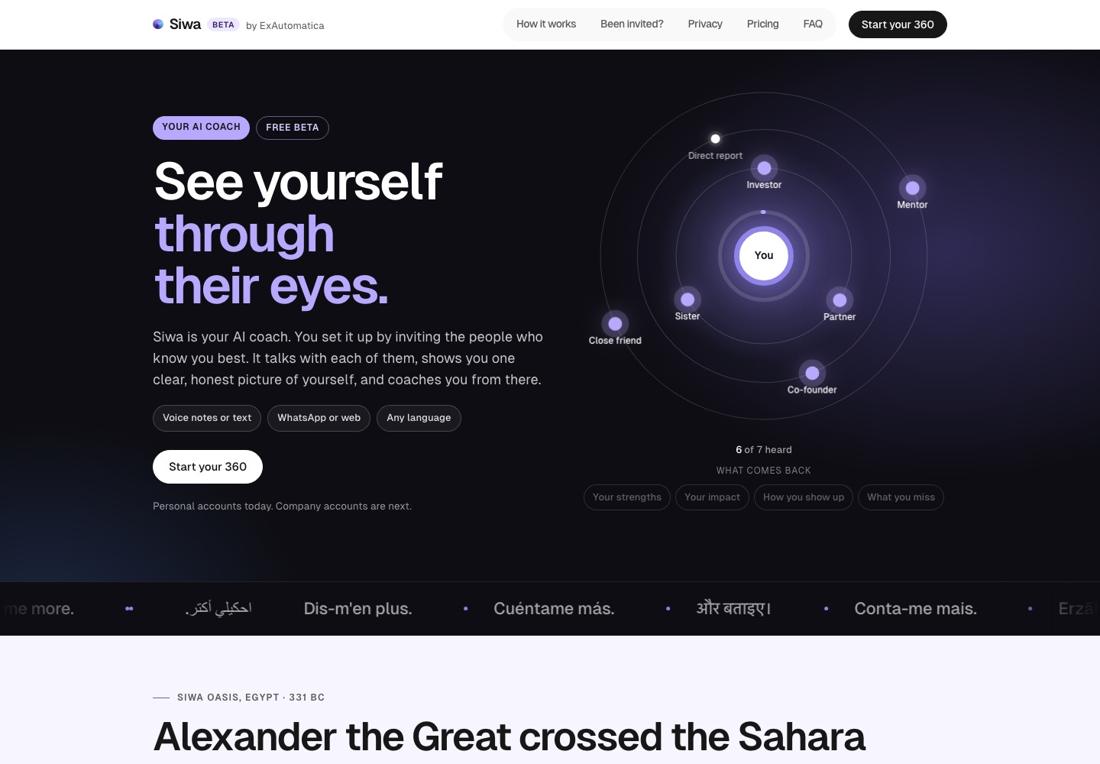
Siwa is that, for anyone. You invite the people who know you. Siwa talks to each of them, puts what it heard together into one clear picture of you, shows you the picture, and then coaches you from it. The picture is the opening brief, not the deliverable. Most feedback dies at the report; Siwa starts there.
It works by voice or text, on WhatsApp or on the web. The people you invite do not install anything. They answer on their phone, in their own words, in the gaps of a normal day. That is the whole trick. A conversation is something people will give you. A form is something they owe you.

Siwa
An AI coach set up by the people who know you. It talks with each of them, shows you one clear picture of yourself, and coaches you from there. Voice or text, WhatsApp or web.
What it took to build
This is where the easy version of the story ends. Chiron is an OpenClaw agent: one process, one person, one phone number, one memory. That is what OpenClaw is for, and it is why I could build him in an evening. It is also exactly what you cannot ship to strangers. Siwa has to be one number that holds thousands of sealed relationships at once, and inside each one it has to run several different conversations: the person’s own interview, a separate private interview with each of the people they invite, the report, and then months of coaching. The interviewer talking to your co-founder has to know everything Siwa knows about you and give away none of it. The coach talking to you has to use what your co-founder said and never attribute it. None of that comes with a one-to-one agent. You build it.
So the brain moved out of the agent and into a product. The judgement still comes from the same model that runs Chiron, invoked with one person’s sealed context each time it is needed and gone when it is done. Around it sits the plumbing that makes one-to-many possible: a conversation backbone that routes every message to the right sealed room and decides which conversation is running, per-person state that nothing else can read, a scheduler that fires the reminders and the coaching moments, the WhatsApp bridge, and a web app for the people who would rather type. The backbone is the same one UniversalHealthCare.ai already runs its WhatsApp health companion on, in production, with real patients. That is the part most people underestimate. We did not have to learn how to run a conversational product for many people at once under health-grade privacy rules; we had been doing it for a year. Siwa is a second product on a stack that was built to carry more than one.
It is more work than Chiron by an order of magnitude, and most of it is invisible when it works. It should be. Nobody who invites their sister to talk about them wants to think about routing.
The three people
Siwa is an agent, but it was shaped by three people, and each of them did the original version of this for me before there was a product.
Bill Tobin gave me a real 360 on my first day at Kauffman Fellows. It was the first time a room told me what it saw rather than what I had asked it to see, and I have measured every piece of feedback since against it. He is an executive coach, and he was mine.
Rui Da Silva was my health coach while I was living inside the misdiagnosis. He was the one working on the body while the rest of me was working out how to leave.
Malak Kamel is a therapist I tried to bring on during that same stretch, to help me get through it. It did not happen then. It is happening now: she is one of the three building this with me.
Between them: how you work, how you treat your body, how you handle what you feel. The three places a 360 points. I wanted their craft in the product, not their names on a site.
The name
Siwa is an oasis in Egypt’s Western Desert. Alexander crossed the sand to ask its oracle a question about himself. I am Egyptian; I was not going to name a product that does this after anything else. People have always gone a long way to get a straight answer about themselves from someone who could see what they could not. Now the someone is the people you already have, and the long way is a WhatsApp message.
Siwa is live in beta at asksiwa.com. Invite people who will actually tell you the truth. The product cannot fix a polite rater. Nothing can.
One email when something ships.
You're in.